People in criminal law proceedings: key Legal English vocabulary
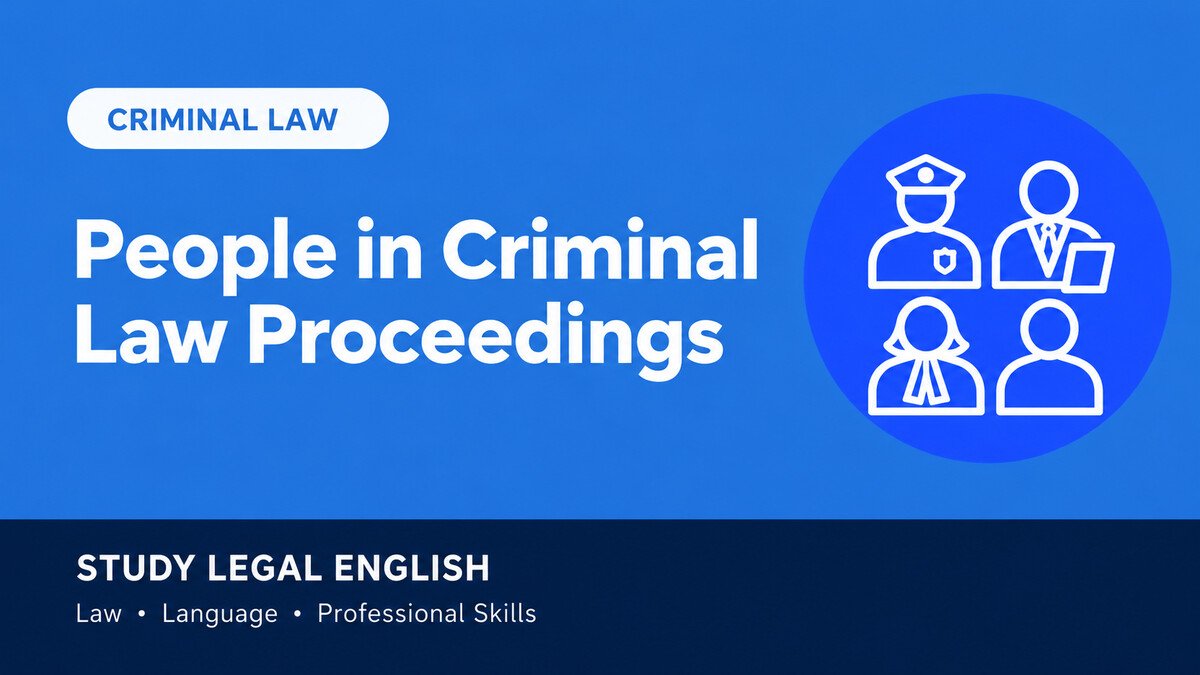
Criminal proceedings involve different people at different stages. The correct noun often depends on what has happened procedurally. A person may be a suspect during an investigation, a defendant at trial and an offender only after guilt has been established.
Lesson handout
The investigation stage
| Term | Meaning | Example and language note |
|---|---|---|
| the police | the organisation responsible for investigating crime and enforcing the law | In British English, we normally say The police are investigating, not the police is investigating. |
| police officer | one person who works for the police | The police officer arrested the suspect. The plural is police officers. |
| suspect | a person whom the police believe may have committed a crime | The police are interviewing several suspects. |
| the accused | a person who has been formally accused of an offence | The accused appeared before the court. |
Common police ranks in England and Wales
From senior to junior, common ranks include commissioner, commander, superintendent, inspector, sergeant and constable.
The prosecution side
| Term | Meaning | Example |
|---|---|---|
| the prosecution | the person, team or authority presenting the criminal case against the defendant | The prosecution states that the fingerprints were found on the weapon. |
| Crown Prosecution Service (CPS) | the public authority that prosecutes criminal cases in England and Wales | The CPS decides whether charges should be brought in many serious or complex cases. |
| prosecutor | a lawyer who presents the case against the defendant | The prosecutor presented evidence to the court. |
Prosecution may take a singular or plural verb in British English, depending on whether you mean the team as one unit or its individual members: The prosecution states … / The prosecution state …. Do not create a plural prosecutions when referring to one side at trial.
The defence side
| Term | Meaning | Example and language note |
|---|---|---|
| the defence / defense | the person or team acting for the defendant | British spelling: defence. American spelling: defense. |
| defendant | the person accused or charged with the offence in court | The defendant is on trial for murder. |
| defence lawyer | a solicitor, barrister or attorney representing the defendant | The defence lawyer challenged the prosecution evidence. |
After the verdict
| Outcome | Useful language | Important point |
|---|---|---|
| Guilty | The defendant was found guilty / was convicted / pleaded guilty / entered a guilty plea. | Offender refers to a person who committed an offence and is especially common in phrases such as repeat offender. |
| Not guilty | The court acquitted my client. My client was acquitted. The defendant was found not guilty. | There is no commonly used single noun that is a direct opposite of offender. Use a phrase instead. |
| Before a verdict | My client is innocent. The alleged offender denies the charge. | Alleged makes clear that guilt has not been established. |
Process: how the label changes
- The police investigate a suspect.
- If the person is formally charged, they may be called the accused.
- In court, that person is the defendant.
- If found guilty, the person may be called an offender.
- If found not guilty, say that the person was acquitted or was found not guilty.
These terms vary between legal systems, so always check the terminology used in the relevant jurisdiction.
🥇 Ways to learn Legal English
- Book Legal English training with Louise.
- Study independently with the Study Legal English courses.
- Read Louise Kulbicki and Natasha Costello’s book, Practical English Language Skills for Lawyers.
- Watch more lessons on the Study Legal English YouTube channel.
- Join the Study Legal English newsletter.
- Connect with Louise on LinkedIn.
Affiliate disclosure: Some book links are Amazon affiliate links. Study Legal English may earn a commission from qualifying purchases, at no additional cost to you.
Legal information changes and develops, so please note that information may have become out of date. For content which is updated regularly, check out my courses.